

Somewhere in your mid-20s, a gradual shift begins. Your body starts making a little less collagen each year, and the slide is steadier than most people realise. Researchers often put the loss at around 1% a year, which sounds tiny until you add up a decade or two of it.
Collagen is the protein that keeps skin firm, hair strong, and joints moving smoothly, so losing it gradually changes how you look and how you feel. The reassuring part is that the decline is predictable, which means you can plan around it rather than be surprised by it.
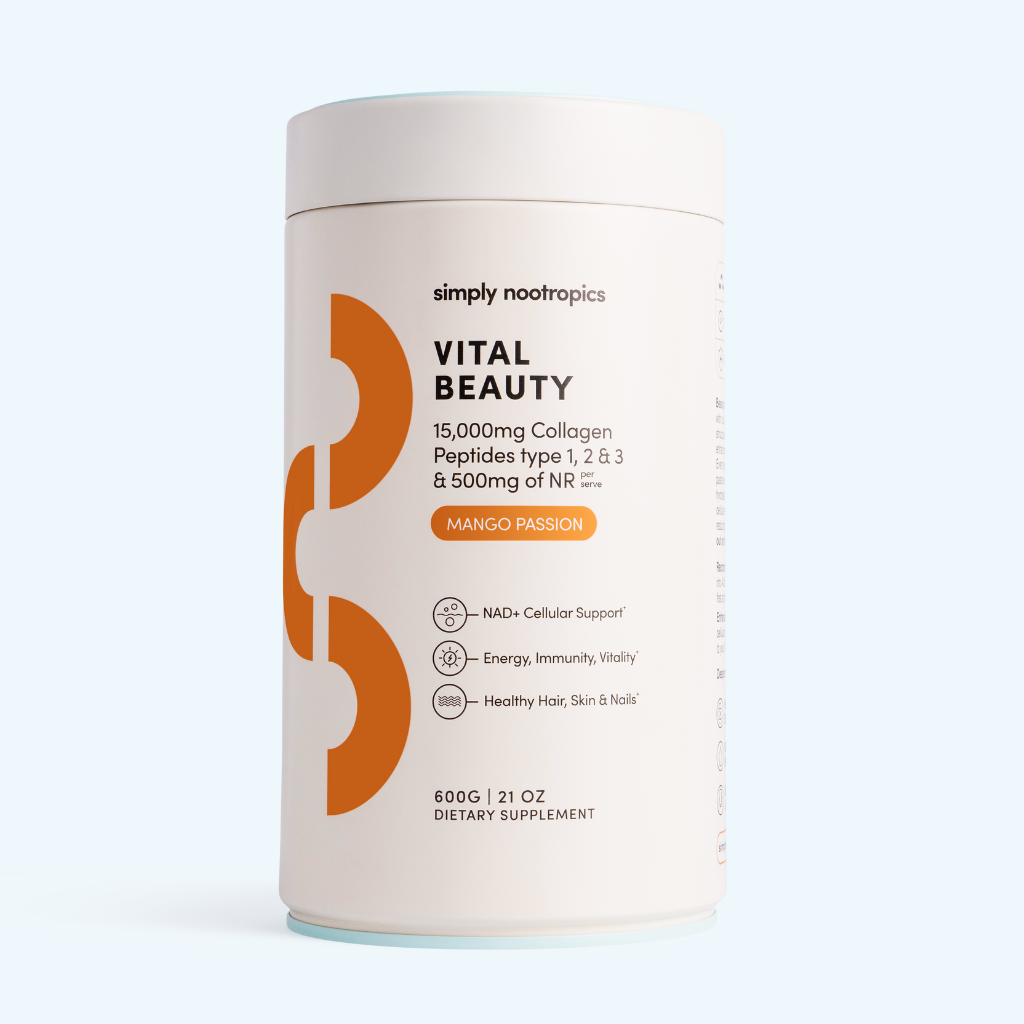
Supporting your body's collagen from the inside, with a formula like Vital Beauty, is one of the simplest ways to stay ahead of the curve. Before we get there, it helps to understand what collagen is actually doing in the first place.
What collagen actually does in your body
Collagen makes up about a third of all the protein in your body, which makes it one of the hardest-working materials you have. It is the scaffolding sitting under your skin, the structure woven through your hair and nails, and a major part of your bones, tendons, cartilage, and joints. When you have plenty of it, skin looks plump and springs back when you press it, joints move without complaint, and hair feels thick and looks glossy.
The easiest way to picture it is as the internal framework that holds everything in place and gives it shape. Your skin sits on top of that framework like fabric over a well-built frame.
When the frame is full and firm, the fabric stays smooth and taut. As the frame thins and loosens, the surface starts to show it, and that is when the familiar signs of ageing begin to appear.
Why the decline starts in your mid-20s
Your body is always doing two things at once with collagen. It builds new collagen, and it breaks old collagen down. Through your teens and early 20s, you build more than you lose, which is why young skin bounces back so easily and heals so fast. Around your mid-20s, that balance quietly tips. Production slows down while the breakdown carries on at its usual pace, and the net result is a gradual loss.
From that point, the commonly cited estimate is a decline of roughly 1% a year. On its own, a single year barely registers. Stretched across your 30s, 40s, and beyond, it adds up to a real and visible reduction.
For many women the pace picks up further around menopause, when hormonal changes speed the loss along. None of this is a fault to be fixed overnight. It is a slow, natural process, and slow processes respond best to steady support.
What the 1% actually looks like
Because the change happens so gradually, you almost never notice it from one day to the next. Over years, though, it shows up in ways that feel familiar to most people as they get older:
-
Fine lines and less bounce in the skin, especially around the eyes and mouth
-
Skin that feels drier, looks a little duller, and takes longer to recover
-
Hair that thins or loses its shine, and nails that split or break more easily
-
Joints that feel stiffer or achier after exercise or a long day on your feet
Seeing these as connected is useful. They are not separate problems with separate causes. They are often the same underlying shift, showing up in the places collagen matters most.
What speeds collagen loss up
Age sets the baseline, but your daily habits decide how fast the decline runs. Some of the biggest accelerators are things you can influence directly.
|
Factor |
Why it matters |
|
Sun exposure |
UV light breaks down existing collagen and slows the production of new fibres |
|
Excess sugar |
Sugar molecules attach to collagen and stiffen it, a process called glycation |
|
Smoking |
It reduces blood flow to the skin and damages the collagen already there |
|
Ongoing stress |
Sustained cortisol interferes with the repair and rebuilding of collagen |
Protecting your collagen is partly about easing off these pressures where you can. Wearing sun protection, keeping sugar moderate, and managing stress all slow the losses. The other half of the job is giving your body what it needs to keep making collagen in the first place.
How to support collagen from the inside
You cannot stop the clock, and any product that claims to is not being honest with you. What you can do is support the process so your body keeps producing and holding onto collagen as well as it can. A few reliable approaches work together:
-
Eat enough protein, since the amino acids in it are the raw material your body turns into collagen
-
Get plenty of vitamin C, which your body genuinely needs in order to build collagen at all
-
Protect your skin from sun and keep yourself well hydrated day to day
-
Consider hydrolysed collagen peptides, which are broken down small enough for your body to absorb and put to work
Food comes first, always. A daily collagen drink then makes the peptide part easy and consistent, and consistency is what turns small daily habits into visible results over the months that follow.
Most people find a routine sticks far better when it takes seconds rather than effort. That is exactly where the right formula earns its place in a routine.
Vital Beauty Collagen
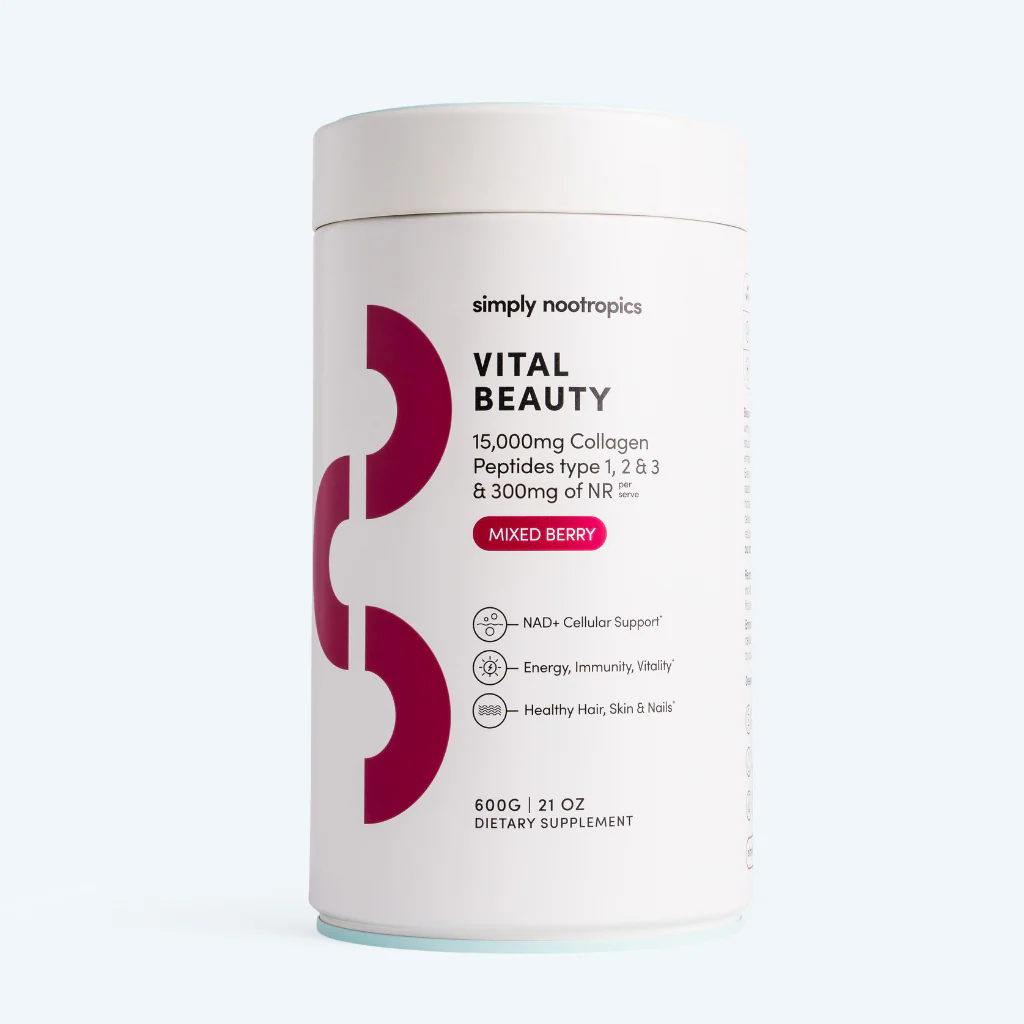
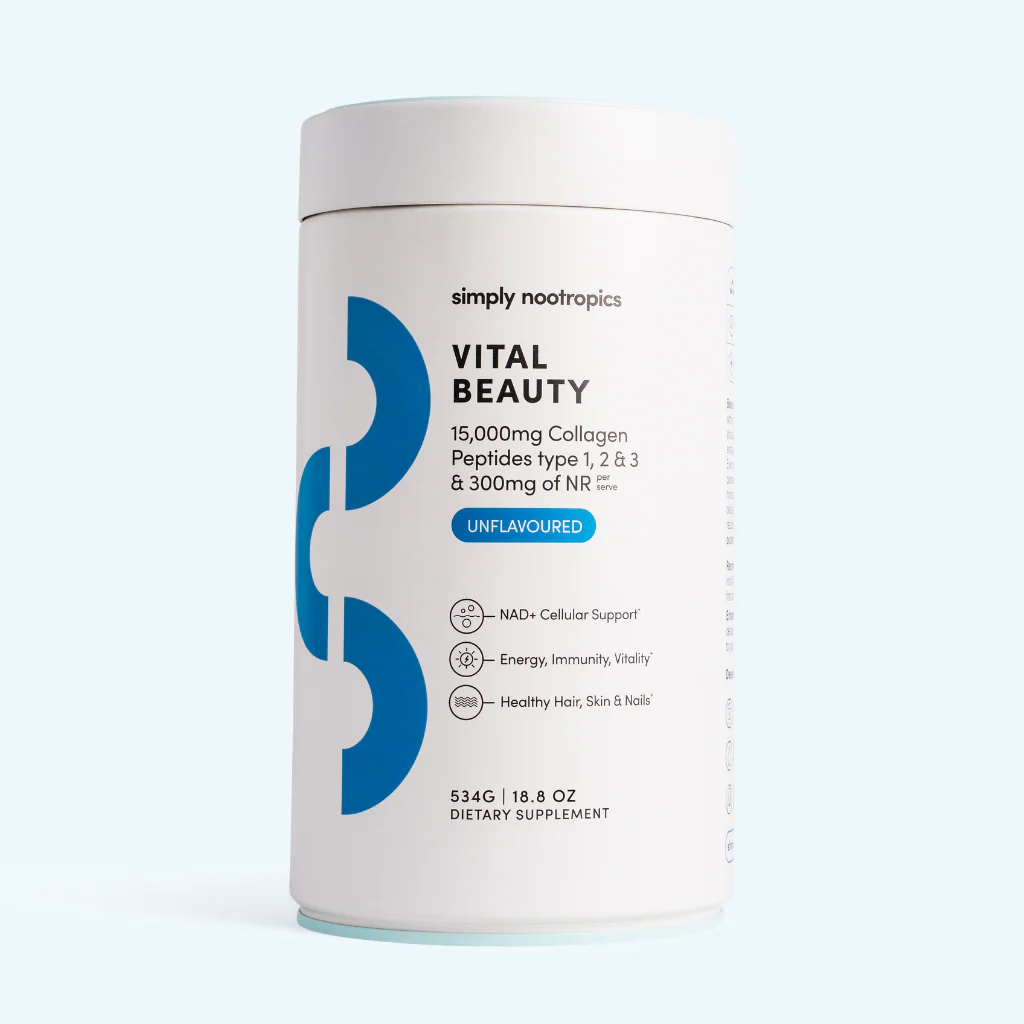
Vital Beauty is built for this stage of life. It uses hydrolysed collagen peptides across Types 1, 2, and 3, sized small so your body can actually absorb and use what you drink rather than passing most of it through.
Around that collagen base sit ingredients chosen to work with it, including vitamin C, hyaluronic acid, and NR, together supporting skin elasticity, hydration, and the kind of healthy ageing that happens quietly beneath the surface.
It stirs into a glass of water in about fifteen seconds, comes in mango passion, mixed berry, or unflavoured, and slots into a morning without any fuss or extra steps. Your collagen may dip a little each year from your mid-20s onward, but a single daily scoop of Vital Beauty is a simple, steady way to keep supporting what your body is always working to replace.